Camden
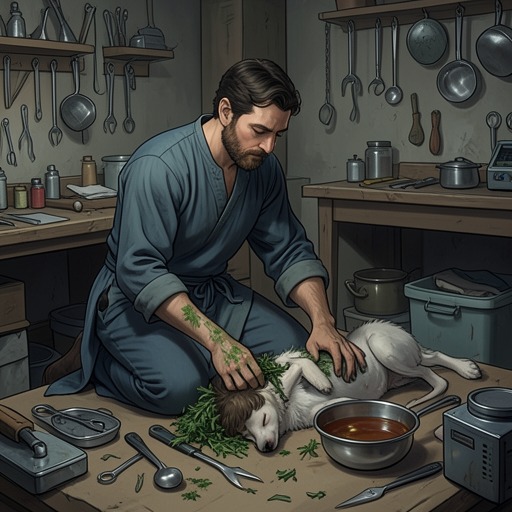
The Reincarnated Demon King's Host Just Wants to Live in Peace, But the Hero Won't Leave Him AloneCamden is the priest who served as healer in Eliza’s Hero’s party and later became Theo’s mentor and foster father. Badly injured during the final battle against Malthios, he lost mobility in both legs and continued his work from a wheeled chair. His importance lies not in being a flawless or all-powerful healer, but in the patient care through which he gives Theo knowledge, ethical grounding, and a model of strength that does not depend on physical ability.
Identity and Background
Camden’s past is inseparable from the war with Malthios. He was the healer attached to Eliza’s party when Malthios was defeated, and Malthios later claimed responsibility for his injuries, smugly telling Theo that he had dropped a pillar on Camden. The damage left Camden unable to move his legs freely, yet it did not erase his authority as the greatest healer available to Theo after the child’s magic test. Camden’s disability is presented as a continuing material condition: he uses a wheeled chair, remembers a time when he could move freely, and acknowledges that he had not trained physically as well as he should have. At the same time, the narrative does not make his body a sign of helplessness. His medical knowledge, teaching, and moral judgment remain active forces throughout the story.
Camden also belongs to the religious world of Arriss, the deity associated with healing, balance, and death. When Theo first came into his care, Camden taught him about deities and worship and gave him a pendant bearing Arriss’s symbol: an antler wrapped in vines. Theo keeps the pendant and wears it constantly because it was the first gift anyone had given him. The object therefore carries Camden’s care beyond the years of formal instruction. It becomes a small, durable token of belonging for a child who believes that the world would condemn him if it discovered that Malthios lives within him.
Mentor and Foster Father
Theo is sent to Camden after the magic test in the capital, where the brilliance of his emerald healing magic causes the court mage to declare that someone with such a gift belongs in the Hero’s party. Theo has no meaningful choice in the decision. His parents are disappointed that his talent will not benefit them, and the next day guards escort him away from home. Camden’s cottage, positioned just outside the nearby town and close to the forest, is consequently more than a training site: it offers Theo distance from the capital’s walls, crowds, and institutional pressure.
Camden welcomes Theo and is pleased to share his teachings. Theo becomes a quick learner, eventually surpassing Camden in raw healing power because he can draw upon Malthios’s immense mana, though he carefully restrains that strength to avoid suspicion. Camden supplies the disciplined practice that makes the power useful, while Malthios contributes memories and knowledge gathered across a long life. Their lessons cover healing, study, and the responsibilities of keeping companions alive. Camden also insists that a healer must be capable of defending himself or protecting someone else when necessary. Because Camden feels he was not physically trained enough in his own youth, he arranges for Sasin, a local adventurer and warrior, to teach Theo hand-to-hand combat and knife work.
The relationship is not uncomplicated for Theo. Camden’s injuries awaken the same misplaced guilt Theo later feels around Glefald: whenever Camden needs assistance or speaks of his former mobility, Theo feels responsible for suffering he did not cause. That guilt contributes to Theo’s recurring belief that the world might be better if he killed himself. Malthios promises to stop him if he tries, but the fact that Theo believes this promise also shows how precarious his emotional life remains. Camden cannot remove that burden simply by being kind; instead, his steady presence gives Theo a reason to continue learning and living within a world that has already assigned him a role.
Separation and Return to the Capital
When Theo is sixteen, he is told to return to the capital to train with the new Hero and the rest of the party. The summons repeats the original pattern of coercion: his magical ability has been claimed by the Hero’s system, and Camden is part of the history that makes the claim possible. Theo later tells Luc that his evaluation at eight led directly to Camden’s cottage and that he had no choice in the matter. Even after building a life as a village healer, Theo remains vulnerable to being taken back by the institutions that first identified him as useful.
Years later, when Theo is forced to return to the capital, Camden is present in a wheeled chair, his face more deeply lined and his body appearing smaller than Theo remembers. The encounter shakes Theo because it makes time, injury, and separation visible at once. Yet Camden does not greet him as a failed apprentice or a criminal. When Theo insists that he will always be a village healer first, despite whatever the authorities force him to do, Camden’s continuing connection to that identity is evident in his actions. He volunteers to go north and take care of Theo’s village during Theo’s absence. The offer protects the home Theo built in Leafel and demonstrates that Camden understands the practical meaning of Theo’s responsibilities better than the court does.
Camden also helps maintain the Hero’s party after Theo’s flight. He explains that Emi’s water magic and Genevieve’s knowledge of botany provide useful cures on the road, while he himself trained Avery in several healing spells. His dry assessment of Avery’s preparation carries affection as well as criticism: Avery is not a bad person, Camden says, but he bears considerable pressure, and Theo’s return may help him. Camden thus remains a teacher not only to Theo but to the wider network of people responsible for one another’s survival.
Defense of Theo
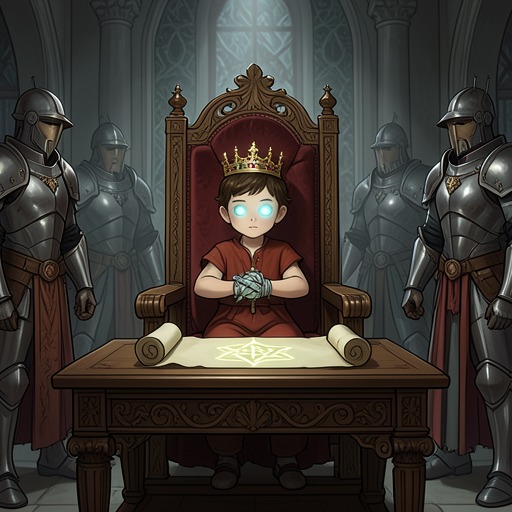
Camden’s decisive action comes during the trial of the Demon King’s host. Once Theo’s identity is exposed, the court uses military procedure and magical communication to bring him to the capital, place him in magic-dampening handcuffs, and imprison him. The court’s language treats Theo as responsible for protecting Malthios and therefore as an extension of the Demon King’s threat. Theo’s fear is not abstract: the capital is the place where his secret was first placed under official scrutiny, and the trial threatens both his life and the safety of Leafel.
The people of Leafel answer that institutional judgment by appearing through a mirror spell. Micah casts the spell from the town square, with Imani, Dale, Dmitri and his parents, Nib, Amaya, Hayden, and the wider community gathered behind him to demand Theo’s release. Camden then addresses the court as someone who raised Theo himself. He declares that he has more reason than most to despise Malthios, but rejects the claim that Theo is guilty for choices he never made. Camden identifies Theo as stronger and kinder than the people judging him and asks whether any of them would have had the will to subdue the Demon King if they had been born in Theo’s position.
This testimony changes the meaning of Camden’s earlier mentorship. He is not merely defending a gifted former student; he is distinguishing Theo from the soul he hosts. The court sees an inherited danger and seeks a punishable culprit. Camden sees a young man who was born into an impossible condition and chose to live peacefully. His authority comes from intimate knowledge: he knows Theo’s history, witnessed his growth, and understands both the danger of Malthios and the character Theo has built in resistance to him.
Character and Narrative Significance
Camden functions as a counterpoint to the Heroic system’s use of children. Theo is identified, evaluated, removed from his family, and assigned to a future party because of his magic. Camden participates in that system as a former party healer and teacher, but his conduct gradually exposes its limits. He teaches survival without treating Theo as a weapon, preserves Theo’s village identity when the court tries to replace it with a heroic one, and finally speaks against the legal and political machinery that wants to punish Theo for his birth.
His disability sharpens that contrast. The story does not present Camden as someone whose value ended when the final battle took his mobility. He continues to heal, teach, organize care, and intervene politically. His wheeled chair is visible in scenes where the court and the Hero’s party might otherwise claim exclusive authority, making his body part of the narrative’s challenge to conventional heroic strength. Camden’s most powerful contribution is not a spell but a testimony: he insists that bodily injury, inherited danger, and institutional classification do not exhaust a person’s identity.
Camden’s relationship with Theo also helps turn survival into chosen family. Theo’s first home was a village shop he built for himself, but Camden’s cottage is the first place where another adult deliberately receives him, educates him, and gives him something meant to last. At the trial, Camden’s defense completes that earlier gift. He names Theo as a person shaped by choices, not as a vessel defined by Malthios, and stands with the community that refuses to abandon him. In the structure of the novel, Camden is therefore both mentor and witness: the teacher who prepares Theo to heal others and the foster father who publicly confirms that Theo has already become more than the fate imposed upon him.